
TNB Electron

TNB Electron: 3D Station Design and Launch Campaign for EV Charging Hubs in Malaysia

TNB Electron, the EV charging arm of Tenaga Nasional Berhad, Malaysia's national electricity utility, lifted aided brand recall among Peninsular EV owners from 18% to 56% over the rollout launch period, on one modular design kit for 37 planned DC charging locations, 80+ 3D assets and launch creative.

Last updated September 2026

The client

TNB Electron is the electric-vehicle charging arm of Tenaga Nasional Berhad, Malaysia's national electricity utility. shakalakaa is a registered vendor to the enterprise, and from TNB Electron's 2023 launch period we worked directly with its team on two things:

More detail on the client
  • the 3D design of its charging stations and bays, and
  • the launch campaign that introduced the network to drivers.
260+

Charge points deployed

Public reporting, February 2026

Planned locations, IEMS 2023
37 DC · 29 ACTNB Electron deployment map
Co-branded sites
Petron · BHPetrol · MaybankPress coverage, 2024–2026
Parent company
Tenaga Nasional Berhadtnb.com.my

Client's own published figures. Not shakalakaa's performance results.

The problem

The network was going onto highway rest-and-service areas (R&Rs) and trunk roads across Peninsular Malaysia — sites run by different operators, with different footprints, all needing to look and work like one national brand.

More detail on the problem

Before the rollout, the programme had 3 pilot test sites and each one had been worked out largely on its own.

Repeating that for every new location would have been slow: an average charging-hub fit-out was taking about 12 weeks, because canopy sizes, bollard positions, lighting and signage were being engineered site by site with contractors on the ground.

  • The brand problem was just as real. Malaysian EV registrations were growing quickly (public reporting puts growth at about 106% year on year, led by the Klang Valley, Johor Bahru and Penang), but only 18% of Peninsular EV owners recognised TNB Electron as a charge point operator before launch.
  • A national utility also carries constraints most brands do not: every station scheme had to clear the Energy Commission (Suruhanjaya Tenaga, ST) and, on highways, the Malaysian Highway Authority (Lembaga Lebuhraya Malaysia, LLM), and every public claim about the network had to be accurate to the record.

What we did

  • One modular station kit.
  • Flagship R&R schemes.
  • Clearance and safety built into the design.
  • Designed for the driver.
  • The launch itself.
  • A shared 3D reference.
More detail on what we did
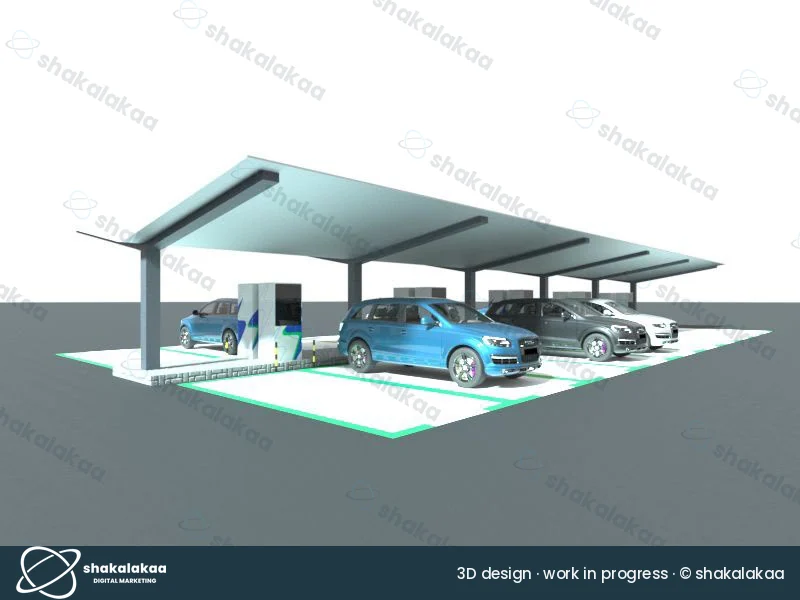
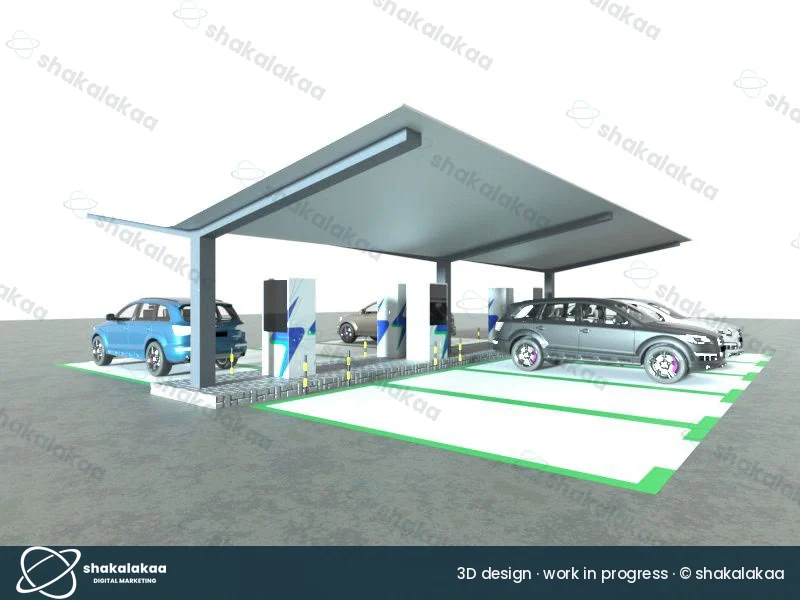
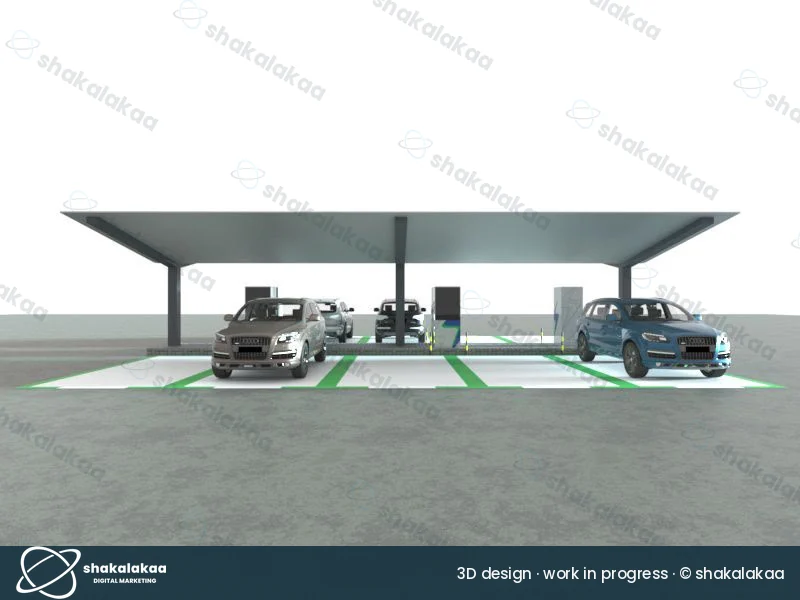
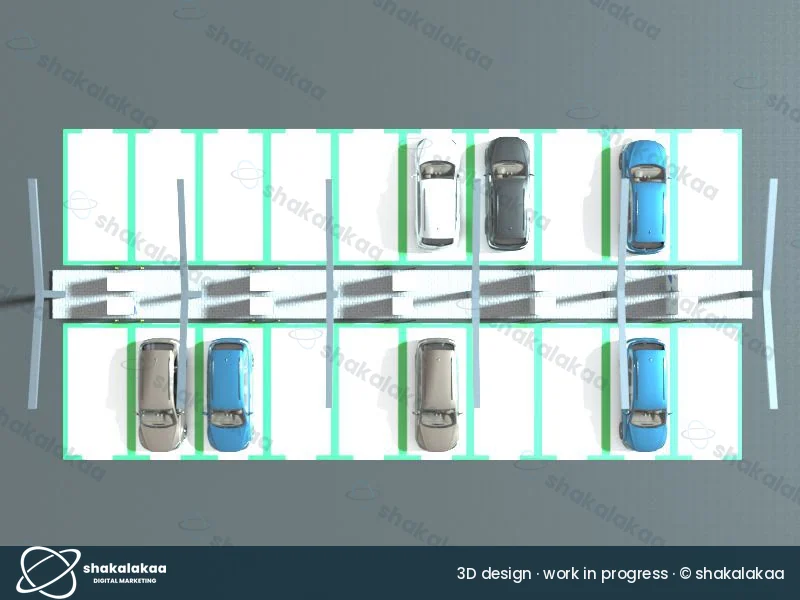
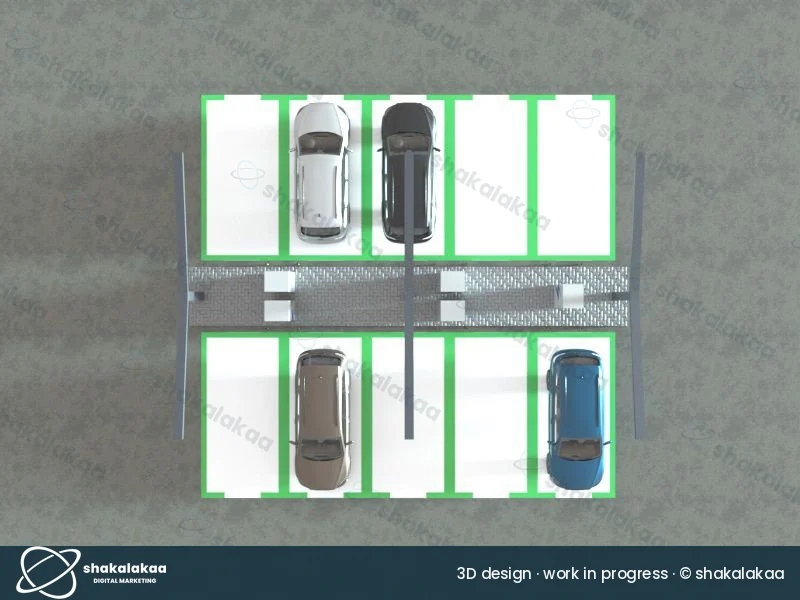
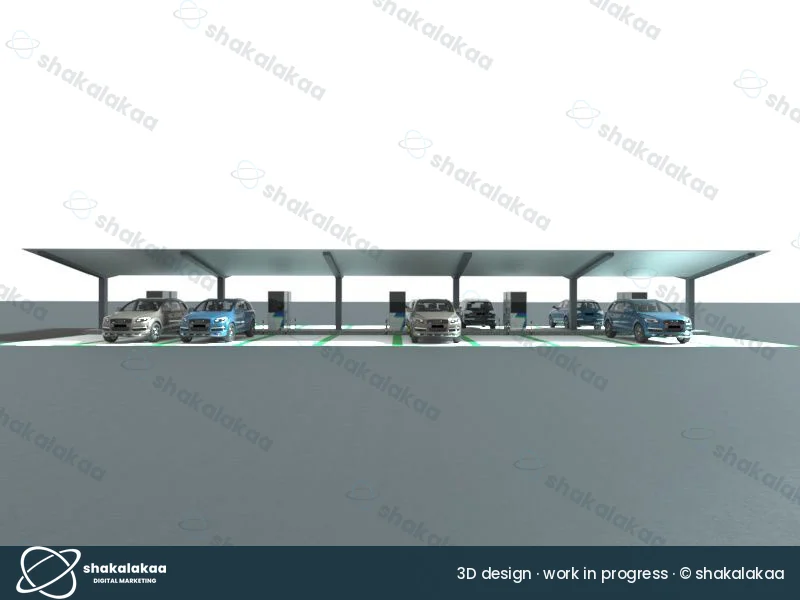
  • One modular station kit. Complete 3D station architecture — canopy structures, modular vehicle-bay footprints, bollard placement, lighting and signage specifications — standardised so the same kit could be dropped onto any of the 37 planned DC fast-charging locations, from 80 kW to 200 kW bays.
  • Flagship R&R schemes. Unified spatial guidelines for the Ayer Keroh, Tapah, Paka and Machap highway R&R locations, where the network is most visible to long-distance drivers.
  • Clearance and safety built into the design. Clearance zones for commercial and passenger EVs, with ST electrical safety enclosures and highway safety guidelines worked into the 3D schemes before they went for technical review, so approval did not depend on redesign later.
  • Designed for the driver. Bay layouts with clear manoeuvring paths and eye-level digital payment points, so pulling in, plugging in and paying works without thinking about it.
  • The launch itself. High-contrast canopy graphics, roadside wayfinding and launch key visuals, coordinated with the launch activations that introduced TNB Electron as a national EV charging brand.
  • A shared 3D reference. The same 3D models served internal engineering teams, civil contractors and marketing — for government presentations, investor updates and public launch media — so every group worked from one picture of the station.

The sketches below are working drafts from the design stage, shown as they were in progress. They are not the final built stations.

What we delivered

80+

3D spatial assets built

Photorealistic day and night canopy renders, bay layouts and markings, vehicle-clearance simulations and environmental guidelines.

37

planned DC charging locations on one design kit

Standardised from 3 pilot sites; DC fast-charging bays from 80 kW to 200 kW.

4

flagship highway R&R schemes

Ayer Keroh, Tapah, Paka and Machap.

Deliverable counts, supplied by shakalakaa. Not performance metrics.
Results (rollout launch period)

Metric Before After
DC charging locations on one standard design kit 3 pilot sites 37 planned locations
Aided brand recall of TNB Electron among Peninsular EV owners 18% 56% (+211%)
3D station schemes cleared by ST and LLM technical review first time — 100% (zero structural redesign orders)
Average site fit-out time per charging hub 12 weeks 6.5 weeks (−46%)
Weekly charging sessions per station, initial launch hubs (flagships: Ayer Keroh and Tapah) 140 480 (3.4×)
3D spatial assets built — 80+
More detail on results (rollout launch period)
  • Sources: TNBX charge point operator registry and highway concessionaire deployment map (locations); an independent Malaysian EV owners brand-tracking study, aided recall, measured within six months of launch (recall); Suruhanjaya Tenaga and Lembaga Lebuhraya Malaysia technical submission reviews (approvals); TNB infrastructure PMO tracking and civil-contractor handover milestones (fit-out);
  • TNBX and Go To-U charging telemetry, paid charging sessions, within 90 days of commercial launch (sessions); agency production delivery manifest (assets). These are results for the programme during the engagement: the network, its pricing and TNB Electron's own launch activity drove them alongside the design and campaign work.

What this means for your enterprise

The plain-language version.

More detail on What this means for your enterprise

Instead of designing every charging station from scratch, TNB Electron got one station kit that works on any site — so building a hub went from about 12 weeks to 6.5, and every scheme in the kit cleared the regulators first time.

More detail on what this means for your enterprise

After launch, recognition of the brand among Peninsular EV owners rose from 18% to 56%, and weekly charging sessions at the launch hubs grew from 140 to 480 per station within 90 days.

What this says about shakalakaa for an enterprise buyer: we can take a physical rollout's visual system from sketch to a standard that contractors build from, then launch it to the public — inside a government-linked enterprise's procurement, approval and regulatory chain.

Related

Keep exploring

FAQ

Frequently asked questions

What did shakalakaa do for TNB Electron?

Two things, from the network's 2023 launch period: the 3D design of its charging stations and bays — one modular canopy and bay kit for the 37 planned DC fast-charging locations, flagship schemes for the Ayer Keroh, Tapah, Paka and Machap highway R&Rs, and 80+ 3D assets

— and the launch campaign that introduced the network to drivers.

What were the results?

Over the rollout launch period: site fit-out per charging hub down from 12 weeks to 6.5 weeks (−46%); every 3D station scheme cleared Suruhanjaya Tenaga and Lembaga Lebuhraya Malaysia technical review first time; aided brand recall among Peninsular EV owners up from 18% to 56% within six months;

and weekly charging sessions per station at the initial launch hubs up from 140 to 480 within 90 days.

Are the images on this page the finished stations?

No. They are work-in-progress design sketches from the design stage, shown as they were. The built stations follow the finished design kit.

Is this an ongoing engagement?

The design and launch work described here is dated to the network's launch period, which began in 2023. Vendor registration with Tenaga Nasional Berhad is a separate and continuing status.

Does this mean shakalakaa specialises in energy or EV marketing?

No. It is a credential for enterprise, government-linked and regulated-sector work generally — physical rollouts, public launches and long approval chains. shakalakaa does not run a dedicated EV or energy vertical.

Let's talk

Let's start the convo.

Want results like this for your own enterprise?

Book a call